39 Tran Quy Kien, Binh Trung, Ho Chi Minh, Vietnam, Thành phố Hồ Chí Minh, 700000, Viet Nam
Lab tags:
1. Executive Summary
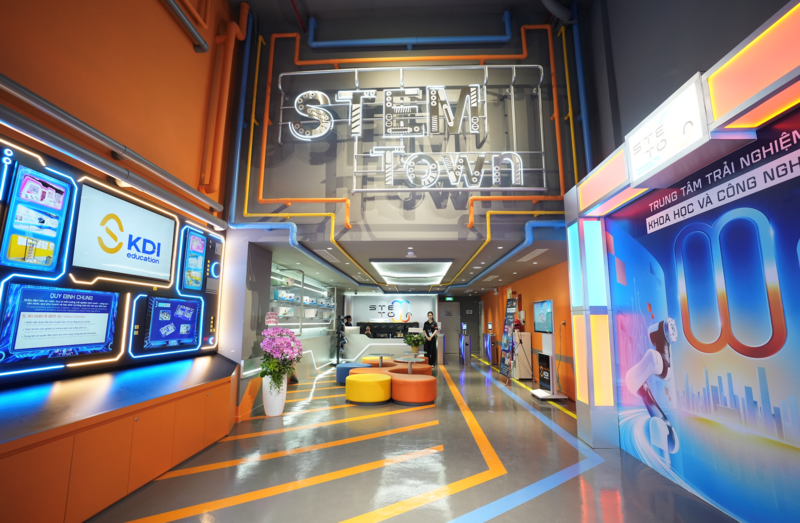
STEM TOWN is a purpose-built, full-stack STEM and digital fabrication center located in Vietnam, designed as an immersive learning environment where children, students, educators, and innovators encounter modern technology through hands-on making. Spanning eight interconnected zones (Drone, AR/VR, AI, IoT, Robotics, Interactive Science, Invention Workshop, and Digital Fabrication), STEM TOWN combines DIY-grade, education-grade, and industrial-grade equipment under a single roof, serving as both a public-access discovery space and a structured project-based learning campus.
We hereby apply to join the global Fab Lab Network because our mission, our pedagogy, and our facility are deeply aligned with the founding spirit of Fab Labs: democratizing access to the tools of digital fabrication and empowering anyone, anywhere, to make almost anything.
2. Mission and Vision
Our mission is to prepare a generation of Vietnamese learners who are not replaced by automation but who lead it. We do this by transforming abstract STEM concepts into tangible, joyful experiences and by guiding learners along a journey from curiosity to mastery to creation.
Our vision is to operate as a node in the worldwide Fab Lab Network, contributing local talent, original projects, and pedagogical insight while drawing on the collective wisdom, curricula, and collaborative spirit of the global community.
3. Educational Philosophy
STEM TOWN is built on four philosophical pillars that we believe resonate strongly with the Fab Charter and the broader Fab Lab ethos.
1. Emotion as the gateway to capability. Beyond the conventional Knowledge–Skills–Attitude triad, we explicitly add Emotion as a starting point. Wonder, surprise, and delight are the entry points that lead learners into deep technical inquiry.
2. Three-level model of creative competence. Level 1 (executing a known process), Level 2 (devising a process for a defined goal), and Level 3 (identifying problems worth solving and designing the entire solution). Our highest aim is Level 3, the human capability that AI cannot replicate.
3. Growth mindset and the freedom to fail. We deliberately cultivate the courage to try, fail, debug, and iterate. A broken circuit, a misbehaving robot, and an unsuccessful print are framed as essential features of the creative process, not as failures.
4. Ownership of the project. The learner, not the teacher, owns the problem, the design, and the artifact. Teachers act as facilitators, mentors, and partners.
4. Pedagogical Framework
Our core method is project-based learning expressed through the Engineering Design Project (EDP) cycle: Problem, Research, Design, Build, Test, Iterate. We make this cycle accessible to every learner through a routine called See–Think–Wonder–Ideate–Do, which guides students from passive observation of a rich technological environment to active creation of original artifacts.
Three program tracks operate concurrently within the facility.
1. B2B Discovery Tours, serving 250 to 300 students per session from partner schools during weekday hours. The tour is structured as a curated narrative across the eight zones, designed to ignite curiosity rather than deliver content.
2. B2C Discovery Tours, open to families and walk-in visitors during evenings and weekends, serving 100 to 150 visitors per session.
3. B2C Long-term Courses, with class sizes of 10 to 12 students, covering 3D design and digital fabrication, electronics and microcontrollers, robotics assembly and programming, IoT, computer vision and AI, and engineering project work.
5. Facility, Tools, and Processes
STEM TOWN occupies a purpose-designed space organized around eight interconnected zones, supporting both demonstration and production work. Equipment is intentionally layered into three tiers so that learners experience digital fabrication as a continuum from accessible DIY making to professional industrial practice.
Tier 1: DIY-grade equipment that students themselves can use to fabricate parts and devices, including 3D printers, laser cutters, Arduino-based microcontrollers, and standard electronics components and tools.
Tier 2: Education-grade kits for structured learning, including robotics kits, IoT kits, and modular electronics platforms.
Tier 3: Industry- and research-grade equipment that connects learners to real-world applications, including industrial robotic arms (Dobot), quadruped robots (Unitree), and autonomous vehicle development platforms based on NVIDIA Jetson Nano.
Specifically, the Digital Fabrication Zone and Invention Workshop already include the core machines required by the Fab Lab Inventory, including laser cutting, 3D printing, and electronics prototyping capabilities. We are committed to expanding our inventory to fully match the Fab Lab Inventory standard, including a high-resolution CNC milling machine for circuit boards and precision parts and a large-format CNC router, so that designs created at STEM TOWN can be reproduced at any Fab Lab worldwide and vice versa.
6. Alignment with the Four Fab Lab Criteria
We have studied the Fab Foundation criteria carefully and outline our alignment below.
1. Public access. STEM TOWN already operates with extensive public access. Our weekend B2C tours and selected weekday evening sessions are open to the general public. We commit to formally designating dedicated open-access hours each week during which the facility is freely available, in-kind, or by barter, in keeping with the Fab Charter spirit.
2. Adherence to the Fab Charter. STEM TOWN endorses the Fab Charter in full, including its provisions on safety, operations, knowledge sharing, intellectual property, and the relationship between commercial activity and the lab. Our pedagogical commitment to documentation and shared learning aligns naturally with the Charter’s knowledge-sharing requirement.
3. Common tools and processes. Our existing inventory already overlaps significantly with the Fab Lab Inventory, particularly in 3D printing, laser cutting, electronics prototyping, and microcontroller programming. We commit to a defined roadmap for completing the standard Fab Lab toolkit within twelve months of acceptance into the network.
4. Participation in the global network. We commit to active participation, including attendance at the weekly Fab Lab video conferences, presence at FAB events, collaboration with neighboring labs in Southeast Asia, and ultimately the hosting of Fab Academy nodes once our team completes the necessary training.
7. Community Impact and Reach
STEM TOWN is positioned to deliver meaningful impact at multiple scales.
1. Schools and educators. Our B2B discovery tours bring digital fabrication and modern technology to thousands of K–12 students per year, many of whom would otherwise have no exposure to such tools.
2. Families and the general public. Our B2C tours and courses provide an entry point for parents and learners across the income spectrum, with scholarship and in-kind access pathways under development.
3. Young creators and entrepreneurs. Our long-term courses and the open-access component of the lab will support emerging makers in prototyping personal projects and early-stage product ideas.
4. Teachers and institutions. We plan to host teacher professional development workshops on project-based learning, the Engineering Design Process, and digital fabrication pedagogy.
8. Team and Capability
Our team is structured around the Versatile Mentor model. Each instructor is developed across three competencies: technical expertise in a focus domain (AI, robotics, IoT, digital design, or electronics), facilitation expertise grounded in the EDP method and the See–Think–Wonder–Ideate–Do routine, and empathetic mentorship grounded in active listening and compassionate communication.
We are committed to sending core staff through Fab Academy as the program’s schedule permits, both to deepen our technical foundation and to integrate fully into the global instructor community.
9. Closing Statement
STEM TOWN is more than a facility filled with machines. It is a deliberately designed environment where curiosity, capability, and character grow together. We believe the global Fab Lab Network is the natural home for this work, and we look forward to contributing to and learning from this remarkable community of fabricators, educators, and inventors.
We respectfully submit this application and welcome any feedback, questions, or guidance from the Fab Foundation and the wider network.
Links
- Impressão 3D
- Corte Laser/Gravação
- Para quem é voltado o fablabs.io?