
Tổ 2, Muong Nhe, Viet Nam
Lab tags:
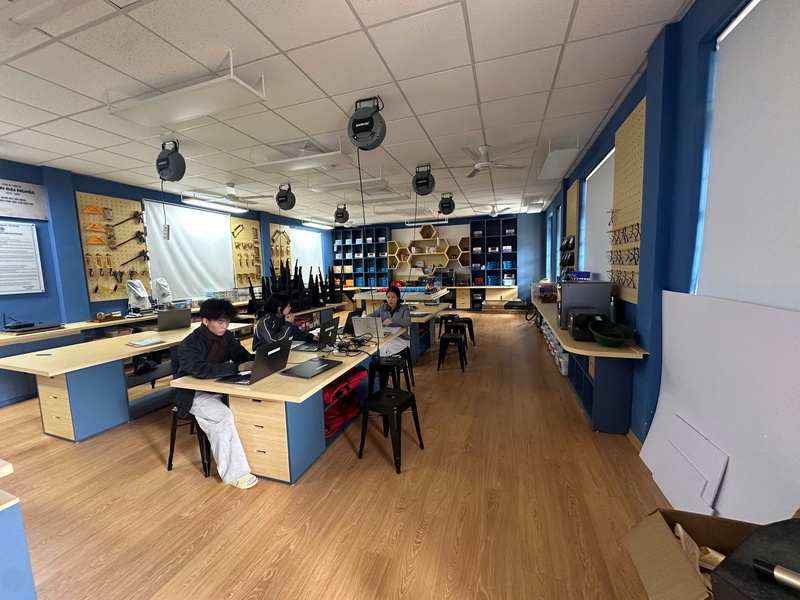
The STEM Lab – Muong Nhe Ethnic Minority Boarding High School is a modern hub for scientific research and technological innovation, designed to modernize teaching and learning for ethnic minority students in Vietnam's westernmost border region.
1. Facilities and Equipment
Designed as a flexible open workspace, the lab supports collaborative teamwork, presentations, and rapid prototyping across four specialized functional zones:
Electronics, Robotics & Automation Zone:
Smart robotics assembly kits, autonomous vehicles, and programmable robotic arms.
Microcontrollers (Arduino, ESP32, Micro:bit, Raspberry Pi), a full suite of sensors (temperature, humidity, light, ultrasonic, infrared), servo/stepper motors, and electronic components.
Digital Fabrication (Makerspace) Zone:
3D Printers: Enable students to design CAD models and fabricate physical mechanical parts and custom enclosures.
Laser Cutters: Provide high-precision cutting and engraving on wood, acrylic, and cardboard for structural frames and technical designs.
Safe electronic soldering stations, mini drill presses, and precision hand tools for product assembly.
IT, Artificial Intelligence (AI) & IoT Zone:
High-performance workstations pre-installed with programming environments (Python, C++, Scratch), circuit simulation software, 3D modeling tools, and AI training platforms.
Large interactive smart displays and high-speed networking to deploy Internet of Things (IoT) systems.
Interdisciplinary Science Experiment Zone:
Digital data-logging sensors and hands-on apparatus integrating Physics, Chemistry, Biology, and Technology.
2. STEM Education Orientation
The lab’s operations are anchored in three core educational pillars:
Connecting Theory to Local Realities: Encouraging students to apply interdisciplinary knowledge (Math, IT, Physics, Chemistry, Biology) to solve practical challenges in Muong Nhe, such as smart agriculture (automated irrigation, weather/landslide alerts), digital preservation of ethnic cultures, and highland environmental protection.
Project-Based Learning (PBL): Shifting from passive instruction to active creation, where students follow the Engineering Design Process—ideating, designing, prototyping, testing, and refining their own inventions.
Spearheading AI and Robotics: Building a core talent pool through STEM and Robotics clubs to master Industry 4.0 technologies and compete in provincial and national arenas.
3. Core Objectives
Bridging the Digital Divide: Ensuring ethnic minority students in remote, disadvantaged areas have equitable access to state-of-the-art technology on par with urban schools.
Developing 21st-Century Competencies: Cultivating logical thinking, complex problem-solving, coding proficiency, teamwork, and scientific presentation skills.
Innovating Teaching Methodologies: Empowering teachers across departments to co-design engaging, interdisciplinary lessons that elevate overall educational quality.
Nurturing Young Innovators: Sustaining and advancing student achievements in Science and Engineering Fairs, Youth Informatics Contests, and the National STEM, AI, and Robotics Championship (VSAR).
Links
- 3D printing
- CNC-Milling
- Circuit production
- Laser
- Precision milling
- Vinyl cutting


